US Dollar - USD
- Turkish Lira - TRY
- US Dollar - USD
- Euro - EUR
- Pound sterling - GBP
- Russian Ruble - RUB
- Chinese Yuan - CNY
- Georgian lari - GEL
- Saudi Riyal - SAR
- UAE Dirham - AED
- Syrian Pound - SYP
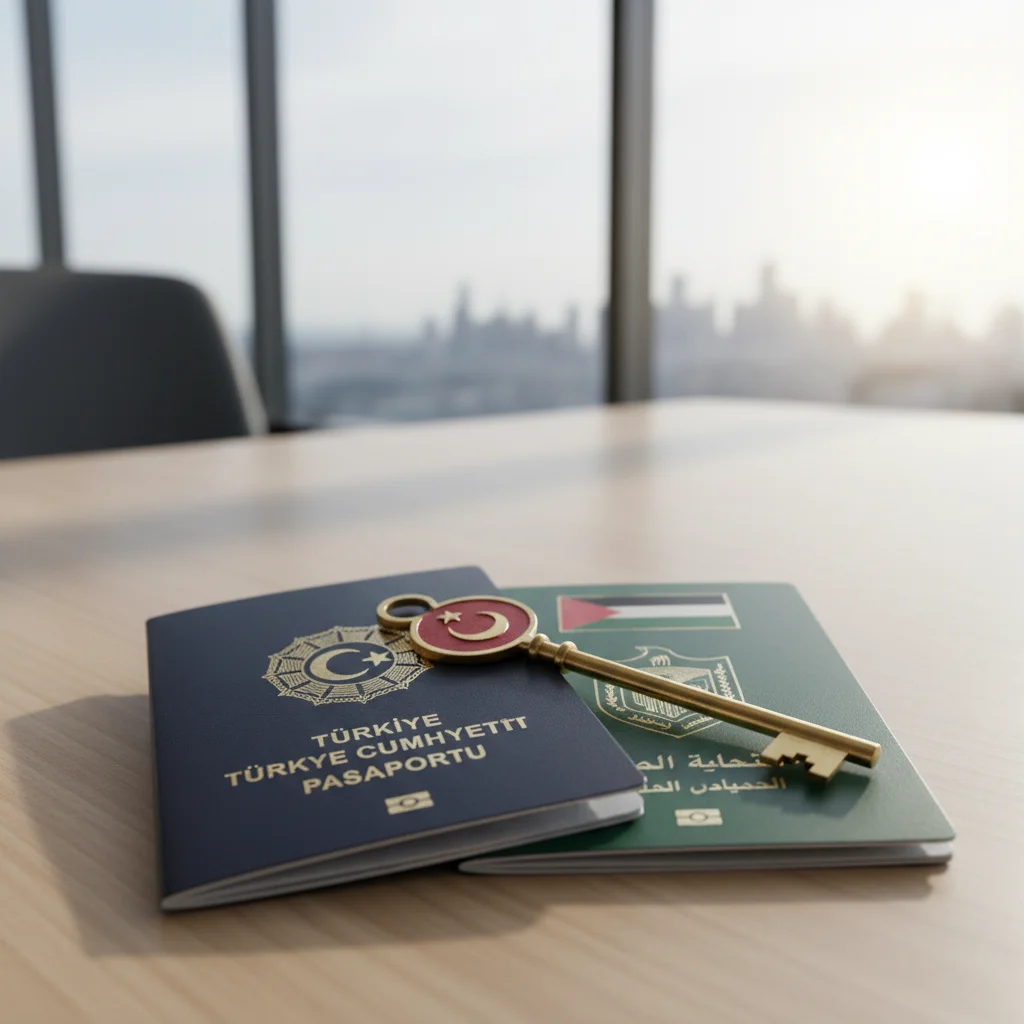
In recent years, the Republic of Turkey has emerged as one of the premier global destinations for foreign direct investment, residency, and citizenship. For Palestinian nationals and Palestinian travel document holders worldwide, securing a second passport or a stable permanent home represents far more than a financial portfolio diversification strategy—it is a pathway toward global mobility, familial security, and lasting economic stability. The Turkish Citizenship by Investment (CBI) program provides a structured, legally sound framework through which eligible Palestinian investors can acquire full citizenship alongside their spouses and dependent children under the age of 18.
Since the sweeping legislative reforms in Turkish property acquisition laws and naturalization procedures, thousands of Arab and Middle Eastern investors have successfully established roots in Turkey. However, Palestinian applicants often navigate unique legal considerations concerning national documentation, international travel papers, consular attestations, and title deed registration rules. Navigating the legal terrain in 2026 demands an up-to-date, transparent understanding of the current real estate investment thresholds, Central Bank exchange regulations, and the exact compliance requirements mandated by the Turkish General Directorate of Land Registry and Cadastre (TKGM) and the Presidency of Migration Management (PMM).
Looking for the best real estate investment opportunity in Istanbul?
We help you choose the right property based on your budget and goals
Get a Free Consultation
A primary point of inquiry among investors centers on whether Palestinian nationals are legally entitled to purchase real estate in Turkey. To understand the current landscape, it is necessary to examine the evolution of Turkish property legislation and the abolition of the strict reciprocity mandate.
Prior to May 2012, Article 35 of the Turkish Land Registry Law No. 2644 strictly enforced the "principle of reciprocity" (Mütekabiliyet), which stipulated that foreign nationals could only purchase immovable property in Turkey if Turkish citizens were granted reciprocal rights in that foreign national's home country. Under this historical statute, many Middle Eastern and Arab nationals faced substantial barriers or outright prohibitions.
With the enactment of Law No. 6302 in May 2012, Turkey formally abolished the reciprocity requirement for citizens of over 183 countries, fundamentally opening the domestic real estate market to international buyers. Under this landmark legislation, Palestinian nationals holding recognized national passports were officially granted the legal capacity to purchase residential, commercial, and agricultural property in Turkey under specific cadastral parameters.
The status of a Palestinian investor’s travel identification plays a pivotal role in the property acquisition and naturalization workflow. Turkish immigration and cadastral authorities distinguish between several categories of Palestinian documentation:
The Turkish Citizenship Law No. 5901, specifically Article 12 as amended by presidential decrees, establishes several objective pathways through which foreign nationals can qualify for exceptional naturalization. For Palestinian investors, four primary avenues exist:
The acquisition of real estate remains the most favored, practical, and yield-generating avenue for Palestinian families. Under the operational regulations applicable in 2026:
For investors preferring liquid financial instruments over physical assets, the capital investment pathway provides a straightforward administrative procedure:
Entrepreneurs seeking to expand commercial operations into Istanbul, Ankara, Izmir, or Bursa can qualify through active job creation:
Beyond direct investment thresholds, Palestinians residing in Turkey under work permits or long-term humanitarian/touristic statuses may pursue naturalization under standard procedures. This path requires five continuous years of legal residency with limited days spent abroad, demonstrated Turkish language proficiency, stable income, and a clean criminal background. However, the investment routes remain vastly faster, bypass language examination mandates, and grant direct citizenship within a matter of months.
The following table presents a structured comparative analysis of the primary routes accessible to Palestinian nationals seeking naturalization via investment:
| Investment Category | Minimum Financial Threshold | Holding Period | Supervising Turkish Authority | Primary Advantages |
|---|---|---|---|---|
| Real Estate Acquisition | $400,000 USD | 3 Years (Registry Annotation) | General Directorate of Land Registry and Cadastre (TKGM) | Capital appreciation, potential foreign-currency rental income, tangible asset ownership. |
| Bank Cash Deposit | $500,000 USD | 3 Years (Account Blockage) | Banking Regulation and Supervision Agency (BDDK) | High liquidity, zero operational property management duties, FX protection schemes. |
| Government Bonds / Funds | $500,000 USD | 3 Years | Capital Markets Board (SPK) / Ministry of Treasury | Passive portfolio growth, structured institutional management, fixed yield potential. |
| Workforce Creation | 50 Full-Time Turkish Employees | Active Operational Term | Ministry of Labor and Social Security (ÇSGB) | Commercial presence in strategic Turkish sectors, exemption from passive asset lockups. |
Securing Turkish citizenship through real estate investment involves a rigorous series of legal, financial, and administrative steps. Ensuring complete synchronization between property conveyance and citizenship documentation is imperative.
Not every property on the market meets the legal criteria for citizenship. Palestinian buyers must verify that the asset carries clean title ownership. Legal due diligence must confirm:
In accordance with Article 13 of the Executive Guide on Foreign Capital Movement, all foreign real estate purchasers must route foreign currency through the Central Bank of Turkey prior to title deed registration. The procedure entails:
With the DAP issued and the property appraisal finalized by a Capital Markets Board (SPK)-licensed independent valuer confirming a minimum value of $400,000 USD, the transaction proceeds to the Land Registry Office (Tapu Müdürlüğü):
Looking for the best real estate investment opportunity in Istanbul?
We help you choose the right property based on your budget and goals
Get a Free Consultation
Following registration, the Land Registry forwards the valuation report, bank receipts, title deed copy, and exchange certificates to the Department of Foreign Affairs at TKGM. Upon verification that the investment meets all statutory conditions, the ministry issues the official Certificate of Conformity (Uygunluk Belgesi). This certificate serves as the official legal foundation permitting the naturalization filing.
Prior to submitting the final naturalization application, the primary investor must secure a specialized short-term residence permit under Article 31, paragraph (j) of the Law on Foreigners and International Protection. Unlike standard tourist visas, the 31/J residence permit:
The completed application dossier is lodged at the specialized Citizenship Bureau (Nüfus ve Vatandaşlık İşleri Genel Müdürlüğü). The file undergoes thorough multi-agency background vetting overseen by the National Intelligence Organization (MİT) and the Ministry of Interior. Once national security clearances conclude successfully, the application is presented to the President of the Republic for final sign-off. Upon issuance of the naturalization decree, applicants visit the civil registry office to provide biometrics and collect their Turkish National Identity Cards (Kimlik) and Passports.
Because documentation structures differ across Palestinian jurisdictions, establishing an impeccable civil record file is vital to prevent procedural delays.
A frequent legal obstacle encountered by Palestinian applicants stems from the Apostille status. The Palestinian Authority is not a signatory to the 1961 Hague Apostille Convention. Consequently, civil documents (birth certificates, marriage certificates, family registers) cannot be legalized via an Apostille stamp. Instead, documents must undergo the traditional consular attestation chain:
For Palestinians holding Lebanese, Syrian, or Jordanian travel documents, comparable legalization chains must be completed through the respective country of issuance's foreign ministry and the accredited Turkish diplomatic mission in that jurisdiction.
The standard naturalization dossier submitted to the Directorate General of Civil Registration and Nationality includes:
Acquiring a Turkish passport yields immediate, transformative benefits for Palestinian business leaders, families, and high-net-worth individuals seeking a secure harbor in the Mediterranean.
Palestinian travel documents often present intense visa challenges, extensive processing queues, and severe movement restrictions. A Turkish passport unlocks:
Turkey’s geographic location at the crossroads of Europe and Asia positions its property sector as an active driver of long-term capital preservation. Key financial aspects include:
Naturalized Turkish citizens enjoy the identical civil and socio-economic rights granted to native-born citizens:
While the investment naturalization procedure is standardized, administrative and market nuances require vigilant execution. Palestinian buyers should observe the following professional guidelines:
The regulatory authority requires that the officially registered purchase price, the foreign currency amount on the DAP certificate, and the appraisal figure issued by an SPK-certified valuer must all individually exceed the statutory $400,000 threshold. In off-plan projects or unvetted secondary properties, appraisal valuations can fall 10% to 20% below commercial asking prices. Investors must demand an advance valuation draft before executing transfers.
Turkish regulations prohibit acquiring property from a foreign national or from a Turkish entity that purchased the property from a foreigner within the preceding three years. Furthermore, a property once utilized to obtain citizenship cannot be re-used by a subsequent investor for another citizenship filing. Engaging experienced real estate and legal advisors ensures complete compliance with these chain-of-title restrictions.
International banking compliance rules (AML/CFT) demand absolute clarity regarding the movement of investment capital into Turkey. Palestinian investors transferring funds from the West Bank, the Gulf region, or European accounts must ensure:
Yes. Turkey fully recognizes dual and multiple citizenships under the Turkish Citizenship Law No. 5901. Palestinian applicants are not required to renounce their Palestinian nationality, Jordanian citizenship, or any other travel document status upon receiving naturalization in Turkey.
Yes. Holders of refugee travel documents can acquire property and obtain Turkish citizenship by investment, provided their legal identity, civil lineage, and birth records can be authoritatively validated through notarized civil documents, consular attestations, and Turkish interior ministry vetting.
No. The citizenship-by-investment program exempts applicants from Turkish language proficiency exams, historical knowledge tests, or compulsory permanent residency days. Applicants are free to live abroad continuously during and after the processing phase.
Under statutory Turkish naturalization rules, only the primary applicant, their legally recognized spouse, and biological or legally adopted children under the age of 18 are granted citizenship under a single investment. Children aged 18 and above must apply independently through a distinct qualifying investment or qualify through employment or general naturalization pathways.
Once the mandatory three-year holding period expires, the investor is legally entitled to sell the property on the open market, repatriate the capital, or re-invest the proceeds. Turkish citizenship is granted permanently for life and is unaffected by the subsequent sale of the investment asset.
From the date of property title deed transfer and issuance of the Certificate of Conformity, the administrative process typically concludes within 3 to 6 months, depending on the speed of international consular attestations and state security clearances.
Information for this guide was sourced from recognized regional real estate, legal, and investment authorities:
• Emlak Platform (emlakplatform.com.tr)
• Mbany Real Estate (mbany.com)
• Massar Istanbul (massaristanbul.com)